

AI is no longer something companies are “experimenting” with. It’s already shaping hiring decisions, salaries, and entire business models. The shift is happening fast and the numbers are hard to ignore.
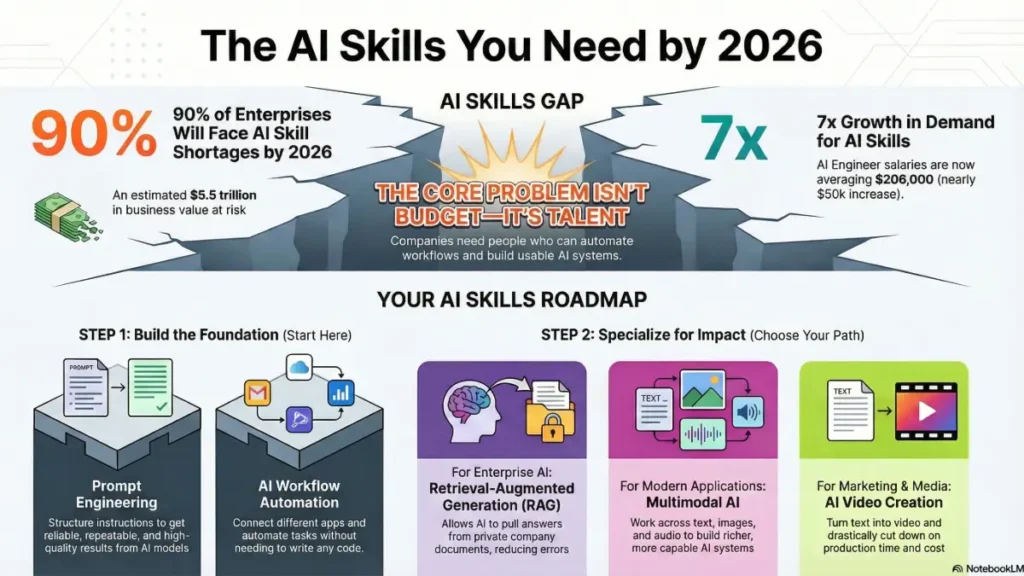
In just two years, demand for AI skills has grown seven times. Prompt engineering alone has seen 135.8% job growth, and AI engineers now earn an average of $206,000 in 2025, nearly $50,000 more than last year.
Yet here’s the real concern: More than 90% of global enterprises are expected to face serious AI skill shortages by 2026, putting an estimated $5.5 trillion at risk due to delayed products, quality issues, and lost revenue.
At TechVitara, This article breaks down the 12 most practical AI skills you should focus on, not theory, not hype, but skills companies are actively hiring for. Each section also highlights tools you can actually use to build real experience.
Why AI Skills Are Becoming Non-Negotiable?
Companies aren’t asking if they should use AI anymore. They’re asking why their teams can’t ship faster, automate more, or reduce costs.
The problem isn’t budget.
The problem is talent.
Even with premium salaries and benefits, organizations are struggling to find people who can:
If you can do even a few of these things well, you instantly become valuable, whether you’re a developer, marketer, founder, or operations lead.
According to McKinsey, today’s AI technologies can theoretically automate more than 50% of current US work hours. That doesn’t mean jobs are disappearing overnight. Instead, roles are changing—some shrinking, some expanding, and many being redesigned around collaboration between humans and intelligent machines.
What’s striking is that most skills are not becoming irrelevant. Over 70% of the skills employers value today are used in both automatable and non-automatable work. The skills remain, but how they’re applied is evolving fast.
The clearest signal of this shift is demand. McKinsey reports that AI fluency, the ability to work with, guide, and manage AI tools—has grown sevenfold in just two years, making it the fastest-growing skill across US job postings. This isn’t limited to tech roles; the surge spans marketing, operations, finance, education, and healthcare.
The economic impact is just as significant. By 2030, McKinsey estimates that $2.9 trillion in value could be unlocked in the US alone, but only if organizations redesign workflows around people, agents, and automation working together, not by simply replacing tasks.
1. Prompt Engineering (The Skill Powering Everything Else)
Prompt engineering is no longer “just typing better questions.” It’s about structuring instructions so AI produces reliable, repeatable results.
This is why it leads AI job growth today and why salaries in prompt-focused roles are rising 28% faster than average tech positions.
What to practice
Tools to practice with
If you’re starting from zero, start here. Every other AI skill becomes easier once this clicks.
2. AI Workflow Automation
Most companies waste hours moving data between tools. AI-driven automation fixes that.
This skill focuses on connecting apps, triggering actions, and letting systems run without constant supervision.
Use cases
Tools
You don’t need coding knowledge, just logic and clarity.
3. AI Agents (Autonomous Task Execution)
AI agents go beyond single prompts. They plan, reason, and act across multiple steps.
Companies are adopting agents for:
Popular frameworks
This skill sits at the intersection of logic, planning, and AI behavior design and demand is growing fast.
4. Retrieval-Augmented Generation (RAG)
RAG solves a major problem with language models: hallucinations.
Instead of relying only on training data, RAG systems pull answers from real documents, databases, or internal knowledge.
Where it’s used
Tools
If you want to work with enterprise AI, this skill is critical.
5. Multimodal AI
Text alone is no longer enough. Modern AI systems now work across:
This opens the door to richer applications—content review, media analysis, and creative workflows.
Tools
Learning how to guide multimodal outputs is becoming a real differentiator.
6. Fine-Tuning & Custom AI Assistants
Companies don’t want generic AI replies. They want tools that match their voice, policies, and workflows.
Fine-tuning allows you to:
Tools
This is where AI starts feeling “built-in” rather than bolted on.
PwC’s latest data reinforces this reality:
The message is clear: AI isn’t eliminating opportunity, it’s reshaping who gets it.
7. Voice AI & Digital Avatars
Voice and video are exploding across training, marketing, and internal communication.
AI now handles:
Tools
This skill is especially valuable for creators, educators, and SaaS teams.
8. AI Tool Stacking (Productivity on Steroids)
Tool stacking is about combining AI, automation, and collaboration platforms into a single workflow.
Think less switching, fewer handoffs, and faster execution.
Common stacks
Tools
Teams that master this save hours every week.
9. AI Video Content Creation
Video is still the highest-engagement format—and AI has cut production time drastically.
You can now:
Tools
This skill is in high demand across marketing and media roles.
10. AI-Powered SaaS Development
You no longer need a full engineering team to launch a product.
AI-powered no-code platforms let you:
Tools
Many solo founders are already building profitable products this way.
11. LLM Monitoring & Optimization
As AI usage grows, so do costs and performance issues.
LLM management focuses on:
Tools
This skill is becoming essential as companies scale AI systems.
12. Staying Current (An Underrated Skill)
AI moves too fast to rely on old knowledge.
The best professionals actively follow:
Reliable sources
Staying informed is part of staying employable.
How to Build Your AI Skill Plan (Without Burnout)?
You don’t need to learn everything at once.
Start simple
Then specialize
Measure progress
Even 3–6 months of consistent practice can put you ahead of most professionals.
Final Thoughts
The AI skills gap is real and it’s growing faster than companies can keep up.
With 90% of enterprises facing shortages by 2026, the opportunity isn’t theoretical. It’s happening right now.
Those who invest time in practical AI skills today won’t just survive the shift they’ll define how work gets done next.
If you’re serious about staying relevant, start now.
FAQs:
What are the skills in AI in 2026?
AI skills include the ability to work with language models, design effective prompts, automate workflows, build AI agents, analyze data, and manage AI systems. Beyond tools, strong AI skills also involve critical thinking, problem framing, and knowing when to trust or question, AI outputs.
What is the most in-demand AI skill right now?
AI fluency is the most in-demand skill today. This means knowing how to use, guide, and manage AI tools in real work settings. Prompt engineering sits at the top of this category and has seen the fastest growth in job demand over the last two years.
What are the main 7 areas of AI?
The seven commonly recognized areas of AI are:
– Machine learning
– Natural language processing
– Computer vision
– Robotics and automation
– Expert systems
– Speech and voice AI
– Planning and decision systems
Most modern AI applications combine more than one of these areas.
What are the 4 types of AI?
AI is often grouped into four broad types:
1. Reactive machines (basic rule-based systems)
2. Limited memory AI (most AI used today)
3. Theory of mind AI (still under research)
4. Self-aware AI (theoretical, not real yet)
Nearly all current tools, including chatbots and agents, fall under limited memory AI.
How will AI be in 2026?
By 2026, AI will be deeply embedded in daily work. Many tasks will be handled by AI agents working alongside people, not replacing them. Jobs will focus more on coordination, judgment, creativity, and oversight, while routine work becomes increasingly automated.
What are the 7 C’s of AI?
The 7 C’s of AI often refer to:
Creativity
Context
Collaboration
Consistency
Control
Compliance
Continuous learning
These principles help ensure AI systems are useful, reliable, and aligned with real-world needs.







Comments are closed.